If you are suddenly scratching uncontrollably and asking yourself how to u get scabies, please take a deep breath before you panic. Scabies is an extremely common, highly treatable skin condition caused by microscopic mites that burrow into the top layer of your skin. Surprisingly, you contract scabies primarily through direct, prolonged skin-to-skin contact with an infected person, or occasionally by sharing infested clothing and bedding. In fact, according to the World Health Organization (WHO), over 200 million people worldwide suffer from this itchy nuisance at any given time. Consequently, getting scabies has nothing to do with personal hygiene and everything to do with simply being near an infected host.
Therefore, you can put away the shame and guilt immediately. Anyone—from corporate executives to toddlers—can catch these uninvited parasites. In this comprehensive guide, we will break down exactly how transmission happens, explore what scientific research reveals about mite behavior, and give you actionable steps to clear your skin for good.
⚡ Key Takeaways: What You Need to Know Right Now
- Primary Cause: Scabies is spread through prolonged, direct skin-to-skin contact (usually lasting at least 10–15 minutes).
- Secondary Vector: Sharing contaminated bedding, towels, or clothing can spread mites, though it is less common.
- No Hygiene Stigma: Mites do not care about cleanliness; they only care about human warmth and blood.
- Delayed Symptoms: First-time cases take 2 to 6 weeks for intense itching to begin after initial exposure.
- Complete Cure: Prescription topical creams (like Permethrin) and oral medications quickly eliminate infestations.
The Microscopic Villain: What Is Scabies?
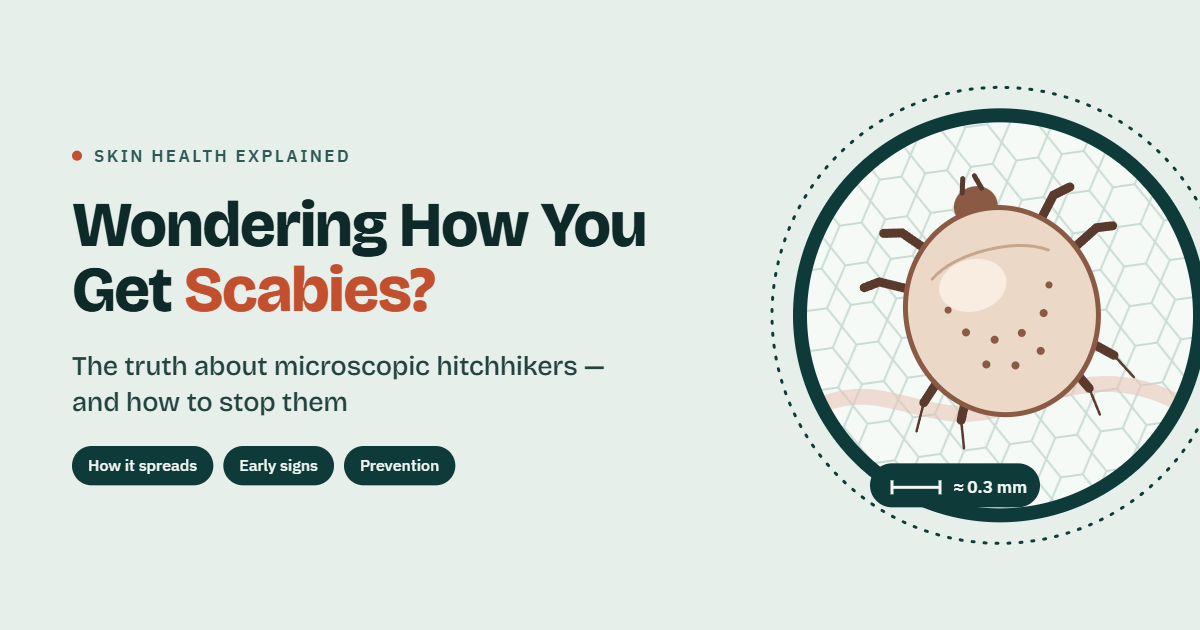
To truly understand transmission, we first need to look at the tiny creature responsible for your discomfort. Scabies is caused by an eight-legged microscopic mite named Sarcoptes scabiei var. hominis. Because these creatures are less than half a millimeter long, you cannot see them with the naked eye.
Once a female mite lands on your skin, she burrows into the outer layer (epidermis) to live and lay eggs. According to clinical entomology research, a single female mite lays 2 to 3 eggs per day during her month-long lifespan. Consequently, your body’s immune system reacts strongly to the mites, their eggs, and their waste products, causing intense allergic itching.
Furthermore, research published in the journal Clinical Microbiology Reviews highlights that most standard scabies infestations involve only 10 to 15 live adult mites on the entire body. However, that small number is more than enough to drive you completely wild with midnight itching fits!
How to U Get Scabies in Daily Life: Main Transmission Routes
Many people wonder how quickly these pests move from one human host to another. Mites cannot fly or jump, which means they rely entirely on physical contact to travel.
1. Prolonged Skin-to-Skin Contact
In the vast majority of cases, direct skin contact is the primary pathway for transmission. However, a quick high-five or a brief handshake is rarely enough to transfer a mite. Instead, transmission usually requires sustained contact lasting 10 to 15 minutes or longer.
For example, intimate partners, sleeping in the same bed, holding hands for extended periods, or caring for young children are prime scenarios for infestation. As a result, households are the most frequent environment for scabies transmission.
2. Sharing Contaminated Fomites (Bedding and Clothes)
In addition to direct physical touch, you can contract scabies through contaminated objects known as fomites. When an infested person sleeps in a bed or wears clothing, mites can drop off onto the fabric.
Studies show that human scabies mites can survive off a host for 48 to 72 hours in normal room conditions. Consequently, if you use an infected person’s bath towel, sheet set, or jacket within that timeframe, a hungry mite may crawl onto you.
3. High-Density Environments
Furthermore, crowded environments significantly increase transmission risk. Research from the Centers for Disease Control and Prevention (CDC) confirms that nursing homes, daycare centers, university dormitories, and extended-care facilities frequently experience scabies outbreaks. Because people live in close physical proximity, mites easily wander between hosts.
Common Myths About Scabies Transmission Debunked
Because scabies carries an unfair social stigma, false rumors about its spread run rampant. Let us dispel a few common myths so you can focus on real solutions.
- Myth 1: You caught scabies from your pet.
Fact: Animals get their own strains of mange, but animal mites cannot survive or reproduce on human skin. Therefore, your dog or cat did not give you human scabies. - Myth 2: Poor hygiene causes scabies.
Fact: Mites are entirely indifferent to how often you shower or what soap you use. In fact, washing with hot water and standard soap will not wash away burrows. - Myth 3: You can get scabies from sitting on a toilet seat.
Fact: Mites prefer warm human body skin over cold plastic surfaces. Consequently, catching scabies from a public toilet seat is virtually impossible.
The Incubation Period: Why You Didn’t Itch Immediately
One of the trickiest aspects of scabies is the long incubation window. When you catch scabies for the very first time, your body does not immediately realize invaders have set up camp.
According to epidemiological studies, it takes between 2 to 6 weeks for your immune system to develop an allergic sensitivity to the mites. During this symptom-free window, you can unknowingly pass scabies to your family members, friends, or sexual partners.
However, if you have had scabies previously, your immune memory kicks in much faster. Consequently, symptoms usually appear within 1 to 4 days after re-exposure, alerting you right away.
Recognizing the Symptoms: How Do You Know You Have It?
Identifying scabies early helps prevent spreading it to others in your household. Look out for these classic signs:
First, experience relentless, severe itching that escalates noticeably at night. Because mites become more active in the warmth of bed covers, nighttime itching is the hallmark signature of an infestation.
Second, inspect your skin for tiny, raised pimple-like rash bumps or thin, grayish-white burrow tracks. Furthermore, these mites have favorite hiding spots across the human body, including:
- The webbed spaces between your fingers and toes
- The inner folds of your wrists and elbows
- Around your waistline and belly button
- The armpits, nipple line, or buttocks
Step-by-Step Guide: How to Eradicate Scabies Completely
If you suspect you have scabies, do not worry! The condition is 100% curable with the right medical approach. Follow these precise steps to eliminate the infestation from your life.
Step 1: Consult a Healthcare Professional
First, visit a dermatologist or general practitioner for an accurate diagnosis. They will often perform a quick skin scraping to confirm the presence of mites or eggs under a microscope.
Step 2: Apply Prescription Scabicides
Next, apply a prescribed topical cream, such as 5% Permethrin cream. You must apply this medication from the neck down to the soles of your feet, making sure to cover every crease, nail bed, and skin fold. Leave the cream on for 8 to 14 hours before washing it off. In addition, doctors may prescribe oral Ivermectin for stubborn cases.
Step 3: Treat the Entire Household Simultaneously
Crucially, every close contact and household member must be treated at the exact same time, even if they have zero itching. Otherwise, family members will endlessly pass mites back and forth to each other like an unwanted game of tag.
Step 4: Decontaminate Your Living Space
Finally, perform a deep environmental wash. Wash all clothing, bed linens, and bath towels used in the past 3 days in hot water (at least 120°F or 50°C). Subsequently, dry them on high heat for at least 20 minutes. For items that cannot be washed, seal them in a plastic trash bag for 3 to 7 days to starve any remaining mites.
Frequently Asked Questions About Scabies
Can you get scabies from a quick handshake or hug?
It is extremely unlikely. Transmission almost always requires prolonged, direct skin-to-skin contact lasting several minutes. Brief interactions like handshakes or casual hugs rarely transfer mites.
How long can scabies mites live on furniture or mattresses?
Human scabies mites can survive away from human skin for about 48 to 72 hours. After 3 days without human heat and blood meals, the mites dehydrate and die completely.
Will scabies go away on its own without treatment?
No, scabies will not resolve on its own. Without proper medical treatment, mites will continue to reproduce, lay eggs, and prolong the infestation indefinitely.
Why am I still itching after using Permethrin cream?
This phenomenon is known as ‘post-scabies itch.’ Even after all mites are dead, your body takes 2 to 4 weeks to shed the dead mite fragments and calm its allergic skin response.